

There is a kind of pain that does not come from losing. It comes from losing a fight you did not know you were in. That is Tanzania’s pain this July.
Somewhere in Dar es Salaam, an official picked up the news the way many of us did, quietly, on a phone screen, between meetings. Aliko Dangote, Africa’s richest man, had chosen Lamu, Kenya, for his $17 billion, 700,000-barrel-a-day refinery. Not Tanga. Not Mombasa, even, which had been the early favorite. Lamu. A place most Tanzanians had never had reason to think about, now sitting on top of the largest single industrial investment East Africa has ever seen.
Let me tell you plainly, the way I would tell it to a minister over tea: Tanzania did not lose this refinery to Kenya’s oil, or to Kenya’s coastline, or to some accident of geography. Tanzania lost it, in large part, to a communications and lobbying gap. And if we do not name that clearly, we will keep losing the next one, and the one after that.
The Story, Told Straight
For months, three neighbors, Kenya, Uganda and Tanzania, ran separate, quiet campaigns to land Dangote’s refinery. Each had a card to play. Uganda had crude oil itself, flowing from the Lake Albert basin. Tanzania had Tanga, a coastline discussed as recently as April, when Dangote stood publicly alongside Presidents Ruto and Museveni to unveil the regional refinery concept. Kenya had neither the oil nor, at first, the cleanest site, Mombasa was Dangote’s early preference, but land disputes and contested port access there raised the risk of legal delay.
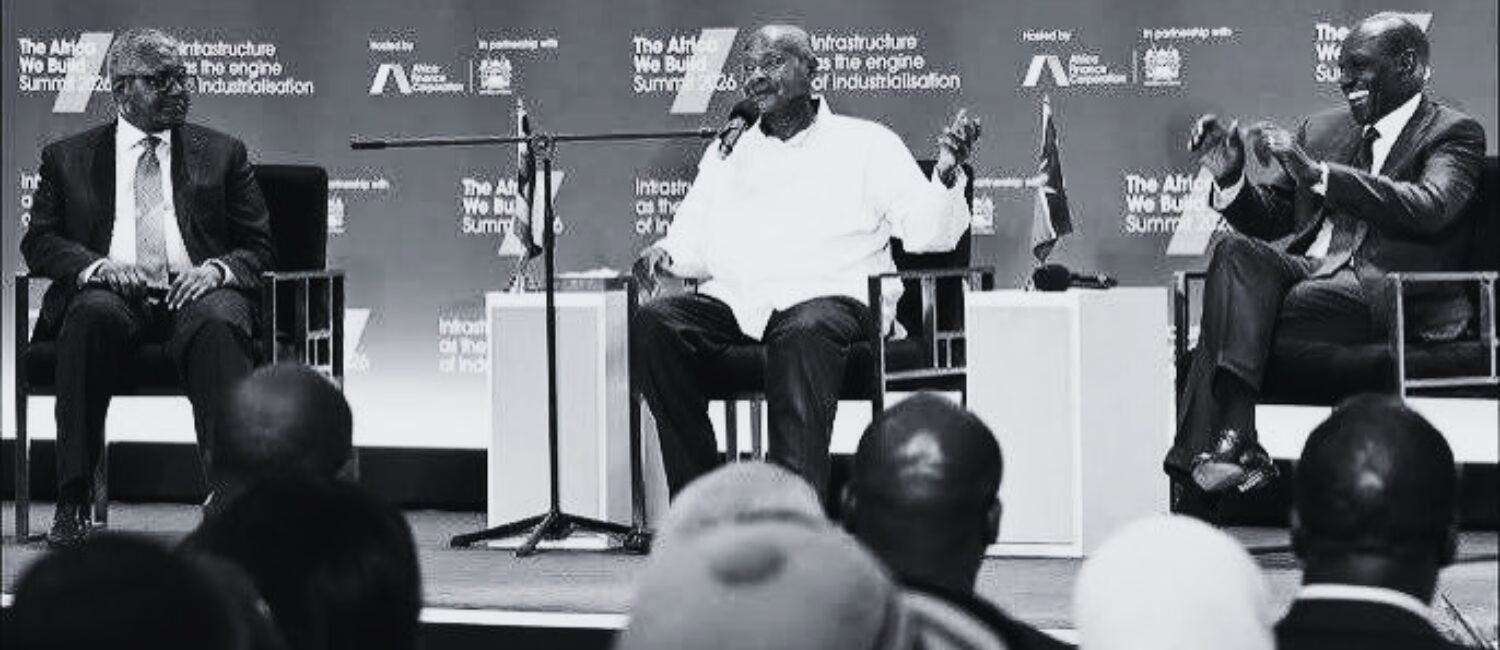
By July, Kenya had it anyway. Not Mombasa in the end, but Lamu, a newer port, fewer competing claims, cleaner title. Deputy President Kithure Kindiki was already leading a dedicated government committee to coordinate with investors months before the announcement. Kenya pledged real seed capital toward the project. Its banking sector, deeper and more liquid than its neighbors’, gave Dangote’s financiers something concrete to underwrite.
And Tanzania? President Samia Suluhu Hassan met Dangote in Dar es Salaam only in mid-May, amid what regional press was already describing as an intensifying contest between Tanga and Mombasa, a contest Tanzania had, by then, already half-missed. Insiders close to the process say Tanzania entered the formal lobbying later than its neighbors, its attention pulled elsewhere by the country’s own post-election recalibration. By the time the two leaders sat down, the commercial and technical judgments that would eventually favor Kenya had, as one person close to the talks put it, “already hardened.”
One line from that reporting deserves to be carved into the wall of every ministry boardroom in Africa: perhaps if Tanzania had joined the conversation early enough, the conversation might have been different.
That is not a story about oil. That is a story about timing, narrative, and who controlled the room while the decision was still soft.
Why This Is a Communications Failure, Not Just a Diplomatic One
Government officials will be tempted to file this under “geopolitics” or “bad luck.” I have sat in enough boardrooms over a decade to tell you that is a comfortable lie. Big capital does not simply arrive and choose the prettiest coastline. It is persuaded, continuously, by people whose job is to remove doubt from an investor’s mind long before the contracts appear. That is communications work. That is lobbying work. And in this contest, Kenya simply did more of it, earlier.
Consider what Kenya’s comms machinery actually delivered, whether or not anyone in Nairobi called it that:
A single, standing message. From the moment Kindiki was appointed to lead the government team, Kenya spoke with one voice about the refinery, one committee, one spokesperson-in-effect, one coordinated story of “we are ready.” Multiple government agencies were not left to freelance their own versions of the truth to different journalists.
A financing story, not just a welcome story. Kenya did not only say “come.” It showed up with pledged capital, a banking sector that could credibly underwrite billions, and a public commitment to protect Dangote against dumped, subsidized fuel imports once the refinery is running, the very protection Nigeria was slow to give the Lagos plant, and a wound Dangote’s team clearly had not forgotten. That is not luck. That is someone inside the Kenyan system doing the unglamorous work of anticipating an investor’s private fears and answering them before they were asked aloud.
Continuous presence, not seasonal enthusiasm. Kenya’s courtship did not start in April. Reporting on the deal noted private consideration of Mombasa and conversations going back further still. Relationships with capital of this size are not won in a single state visit. They are won in the months of quiet calls, briefings, and site visits that happen when nobody is watching and there is no ribbon to cut yet.
Tanzania, by contrast, arrived to a negotiation that was already narrowing, with a strong site and a real story, Tanga, the pipeline linking Uganda’s oilfields through Tanzanian territory, genuine strategic logic, but without the sustained, early, single-voiced campaign that turns a good site into a signed deal.
What the Boardroom Actually Rewards
Here is what more than a decade in these rooms has taught me, and it is the same lesson whether the boardroom is in Lagos, Nairobi, Dar es Salaam or Johannesburg: capital does not reward the loudest country. It rewards the most legible one.

An investor moving $17 billion is not primarily asking “which coastline is prettiest.” He is asking a narrower, colder question: who can I call at 11pm and get a straight answer from, and will that answer still be true tomorrow? Everything a communications strategist does in a lobbying room, the message discipline, the stakeholder mapping, the anticipation of objections, the coordination between ministries so they don’t contradict each other in public, exists to make a country legible to that question.
This is the part our profession does not say loudly enough to power: communications is not decoration on top of the deal. It is part of how the deal gets assessed. A minister who thinks the comms team’s job is to write the press release after the ribbon-cutting has already lost half the value that a comms strategist could have added. By the time there is a ribbon, the real work, trust-building, risk-reduction, narrative control, is finished, for better or worse.
Where Africa, Broadly, Keeps Failing
I will not pretend this is only a Tanzanian story. It is an African one, and it repeats.
We treat communications as reactive, not strategic. Government communications units across the continent are too often built to explain decisions after they are made, not to shape the environment in which decisions get made. The comms person is invited to the press conference. Rarely to the negotiation.

We let internal politics eat external time. Tanzania’s late entry was reportedly tied to its own post-election recalibration, a domestic story consuming the bandwidth that should have gone to a strategic international one. This is not unique to Tanzania. Nearly every African government has, at some point, let a domestic political season swallow the months when a foreign investor’s attention was actually available and moveable.
We compete for capital the way we compete for aid, with charm instead of infrastructure. A state visit and a warm handshake photograph is not a financing package. Kenya won partly on cold, structural things: a deeper banking sector, land with cleaner title, an anti-dumping guarantee already on the table. Charm opens the door. Infrastructure of trust, legal, financial, and narrative closes the deal.
We do not maintain a permanent “investment narrative” function. The countries that win these contests tend to have some standing capacity, inside a presidency, an investment authority, or a dedicated unit, whose only job is to track major capital movements globally and begin building the country’s story before the investor has publicly named a shortlist. By the time Dangote’s name and East Africa’s ambitions were public in April, that window was already closing for whoever hadn’t already been in the room.
How to Rectify It, Practically, Not Poetically
Government officials reading this do not need more sympathy. They need a checklist.
- Give communications a seat before the term sheet, not after. Any ministry or investment authority pursuing capital of this scale should have a senior communications strategist inside the negotiating team from day one, not summoned afterward to announce the outcome.
- Build a standing “capital radar.” Track major continental and global investment decisions in progress, refineries, ports, rail, energy, the way intelligence services track threats. By the time a project is public, as this one was in April, it is often too late to start building your story from zero.
- Speak with one voice, permanently. Kenya’s Kindiki-led committee worked because it collapsed many government voices into one coordinated narrative. Every country chasing serious capital needs an equivalent: one team, one message, one number to call.
- Answer the investor’s fear before it is asked. Kenya’s anti-dumping pledge is the clearest lesson here. Good lobbying communications is not persuasion; it is anticipation. Find out what wounded the investor last time, and address it publicly before he has to raise it privately.
- Treat relationship-building as infrastructure, not diplomacy theatre. A single presidential visit in May cannot undo months of a competitor’s quiet groundwork. Relationship communications with global capital should be continuous, not seasonal.
- Do not let domestic political cycles cannibalize international windows. This requires discipline at the very top, a recognition that some international opportunities have a clock that does not pause for a country’s internal calendar.
The Fair Reading
None of this should read as a burial. Tanzania is not shut out. Dangote himself, after settling on Lamu, reportedly returned to Dar es Salaam to explain the outcome and invite Tanzania into the project regardless, as a regional partner in what he still frames as an East African undertaking. The pipeline linking Uganda’s oil to the Tanzanian coast at Tanga remains a Tanzanian and Ugandan asset, independent of where the refinery itself sits. Tanzanian officials, for their part, have not publicly objected to the outcome; the door to regional participation appears genuinely open, not shut in anyone’s face.
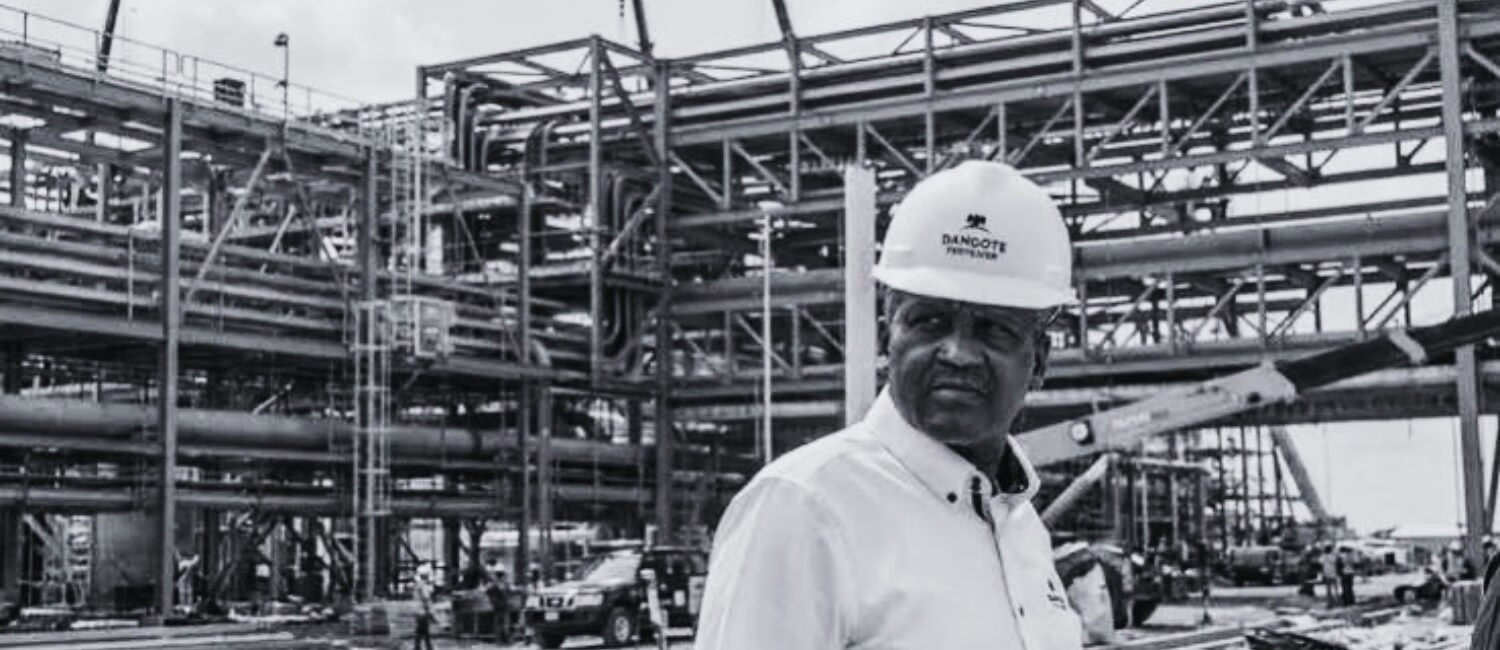
Kenya’s own win, too, was not clean or inevitable. Its first choice, Mombasa, fell away over land disputes. Its coastal communities are already contesting the Lamu site on environmental grounds, arguing, not without cause, that a fossil fuel megaproject sits uneasily beside mangroves, coral reefs and a UNESCO-listed old town. Winning the refinery is not the same as winning the argument about it. Kenya’s comms and lobbying machine will now be tested on a different, harder question: can it hold public trust at home while it held investor trust abroad?
The Question Loth Would Leave You With
Kupanga ni kuchagua, we say. To plan is to choose. Tanzania chose, without perhaps meaning to, to arrive late to a room where the seats were already filling. Kenya chose, deliberately or by instinct, to be in that room months before anyone outside it knew the room existed.
The next mega-deal is already forming somewhere on this continent, right now, while we are reading about the last one. Some government’s comms desk is treating it as tomorrow’s press release. Somewhere else, a strategist is already three months into building the story nobody has asked for yet.
Which room will your country be in when the decision hardens?
#MrProjects