
The fight against human trafficking will not be won by shouting louder. It will be won by communicating smarter.
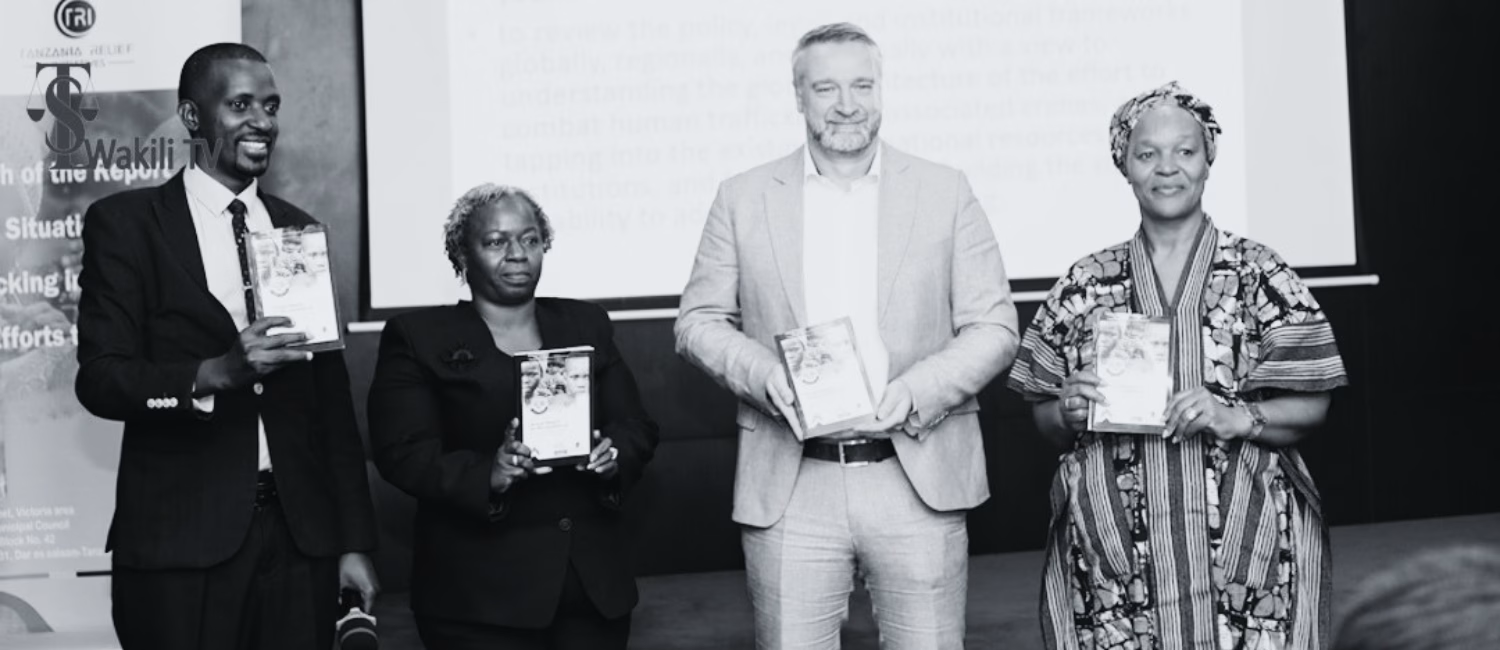
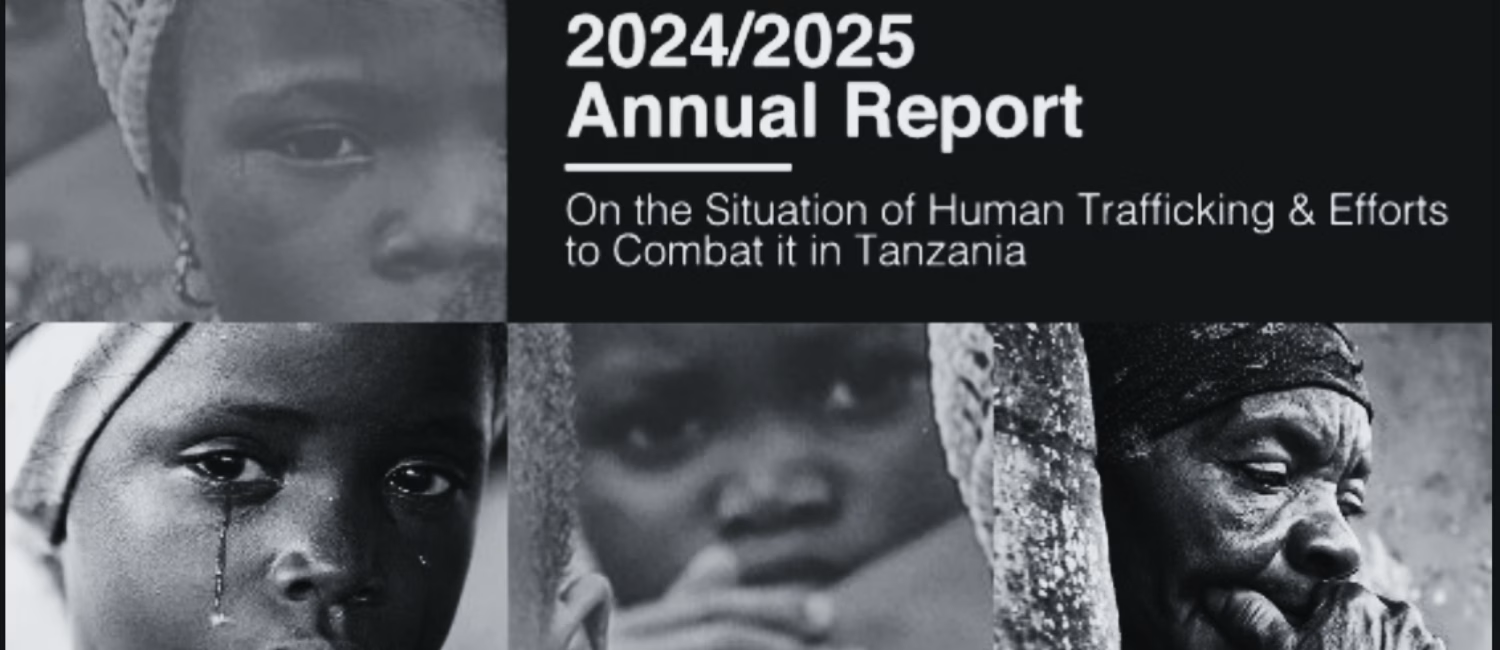
A group of young people from Pwani, Singida, Arusha, Mwanza, Tanga and Dodoma were promised training and a good sales job in Morogoro. On arrival they were locked into a cycle: forced to buy overpriced products, then trained to talk others into doing the same, some coached on how to lie to their own families about their earnings. No one chained them. They were held by words alone, promises, “training,” an engineered system of fake “success.” This is not fiction. It is a documented case from TANAHUT’s 2024/2025 Annual Report — the Tanzania Network Against Human Trafficking, launched on 20 August 2026 in Dar es Salaam.
The Communication War Hiding Inside Human Trafficking
That is where the real problem sits. When we talk about human trafficking, we talk a great deal about police, courts, and law. Rightly so. But there is another war being fought quietly, a war of words, narratives, and trust. And in that war, traffickers are beating us.

TANAHUT’s new report records over 2,400 reported cases across Mainland Tanzania, most from the Eastern Zone, particularly Morogoro, which alone accounts for roughly 1,700 cases. The Lake Zone – Kagera, Mwanza, Mara, Geita and Simiyu follows with 400, driven by proximity to the Great Lakes region, tobacco farming, and small-scale mining that also pulls in nationals from Uganda and Burundi. “Forced criminality” leads by type of exploitation, with over 1,000 recorded incidents, followed by labor and sexual exploitation. Boys feature more in labor exploitation; girls in domestic servitude and sexual exploitation. These aren’t just numbers they’re a map of how traffickers speak to each group in its own language.
Where the Communications Strategist Fits In
This is exactly where the Strategic Communications Strategist should step in, not at the end, printing a poster and pinning it to a wall, but at the beginning, as part of the strategy itself.
From Awareness to Action

For too long we have assumed awareness is the solution. Print a poster saying “Human Trafficking Is a Crime,” and we consider the job done. But knowing is not acting. Those young people in Morogoro already knew the risks existed. What they lacked was an immediate answer: Where do I verify this offer? Who do I call? Where can my family report this without fear? Real communication doesn’t stop at information, it leads to action.
The Communications Strategist‘s work here is not small. It means understanding different segments of society, a young person in Morogoro drawn in by “sales training” is not the same as one in Kagera pulled toward small-scale gold mines, nor the same as a parent in Dar es Salaam signing off on a “job abroad” for their daughter. It means building narratives that counter traffickers’ promises without manufacturing fear that makes people distrust every opportunity, real or fake. It means working with journalists without exposing a survivor twice for a headline. It means aligning government, coalitions like TANAHUT, a network of 105 institutions nationwide, media, and the private sector under one coherent voice.

A Continental Problem Needs a Continental Response
This problem does not stop at the border, and neither should the response. In December 2024, the African Union validated Continental Guidelines for Sharing Information and Intelligence to combat Trafficking in Persons and Smuggling of Migrants, following a workshop in Kampala. Developed by the AU’s Continental Operational Centre, the guidelines call for structured cooperation between member states, regional bodies, and law enforcement. As Interpol’s regional officer for Eastern Africa put it at the workshop, no single nation can fight this battle alone and neither can a single communication campaign. A recruitment message can originate in Dar es Salaam and target a young person in Kampala within minutes; a continental guideline on intelligence-sharing is only as strong as the communication strategy that turns it into a warning a mother in Morogoro can act on.

Survivors Are People, Not Proof Points
And here’s the uncomfortable question: are we communicating to protect people, or to show our organization is doing something? A campaign with a million views can be well-crafted and still ethically wrong, especially when a survivor becomes a prop for sympathy rather than a person with dignity and privacy. Survivor-centered communication means consent before exposure, protection before publicity, and storytelling that restores agency instead of freezing someone permanently in the moment of their exploitation.

Business and Technology Have a Role Too
The private sector cannot opt out either, recruitment, mining, agriculture, and transport companies encounter victims before anyone else does, and a well-communicated fair-recruitment policy is itself a form of protection. Technology cuts both ways too: traffickers use social media and fake job platforms to find and groom targets, but the same tools, social listening, multilingual campaigns, rapid-response reporting, can be turned toward prevention, provided technology supports human judgment rather than replacing it.
Measuring What Actually Matters
Real success isn’t measured in likes or reach. It’s measured by how many people knew who to call, how to verify a job offer, and trusted an institution enough to report without fear. It is measured in reduced exposure to risky recruitment, faster response times, and stronger trust between communities and the institutions meant to protect them.
The Real Battlefield
Traffickers don’t fight with force alone. They fight with carefully crafted words, aimed at the right person, at the right moment, sometimes crossing several borders before anyone notices. Until we understand that, we’ll keep printing posters while they build entire “training” systems that turn victims into new agents of deception. This war won’t be won with a louder voice, it will be won with communication that is closer, earlier, and smarter than the enemy’s.
#MrProjects